
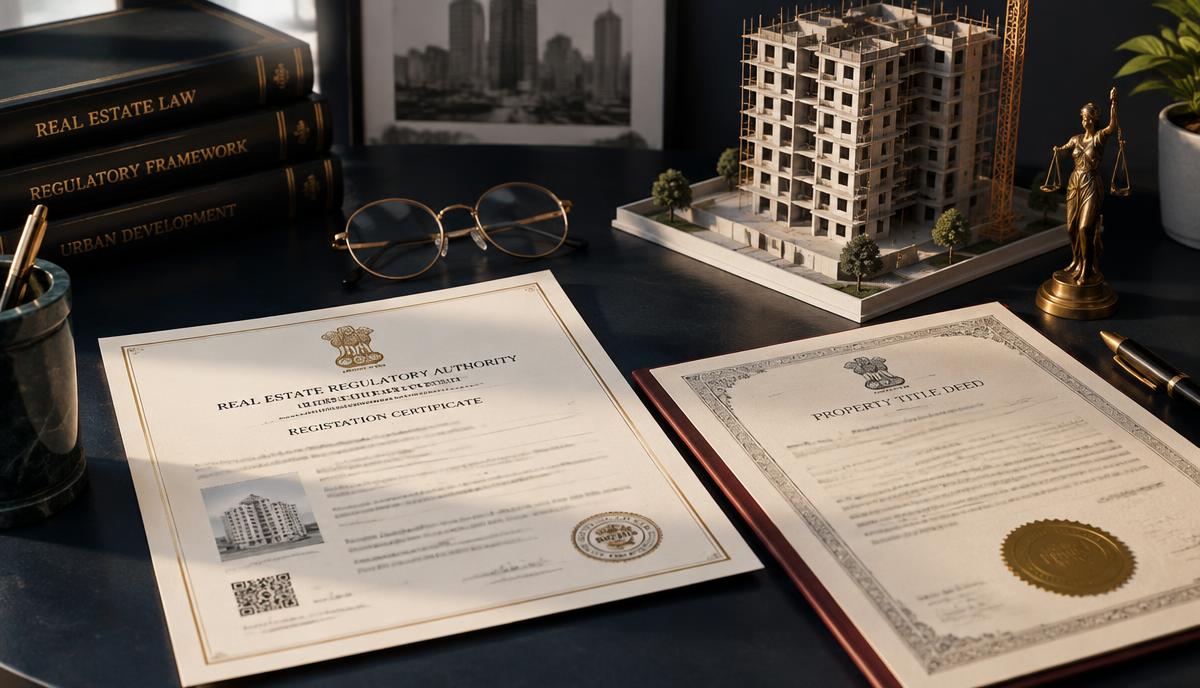
A step-by-step guide to filing a RERA complaint as an NRI property buyer, including what RERA covers, where it does not apply, how to file and attend hearings from abroad, RERA versus consumer court, and title and encumbrance verification before a purchase closes.
An NRI who buys an apartment in Pune from a US address and an NRI who inherits a flat in Kolkata are dealing with different problems, but they share one blind spot: builder delay. When a developer misses a possession date by a year or more, the buyer's main protection is a RERA complaint, filed under the state regulator set up by India's real estate regulation law. This guide walks through what RERA actually covers, how an NRI can file a complaint entirely from abroad, and what to check on the title side before a purchase closes at all, since a clean title matters as much as a registered project.
What RERA Actually Covers
RERA created a regulator in every state to register real estate projects, publish project timelines and approvals, and give buyers a formal complaint route when a developer does not deliver as promised. A registered project has to post its layout plans, promised completion date, and land title status on the state regulator's public portal. That gives a buyer, including one living outside India, a way to check a project's real status before signing anything.
The complaint mechanism itself is meant to be simpler and faster than a regular civil suit. A buyer files a written complaint with the state authority, the builder responds, and the authority holds hearings and issues an order. That order can direct a refund with interest, direct possession by a set date, or award compensation for the delay.
Where RERA Does Not Apply
RERA is not universal. Very small projects below the size threshold set by each state, most purely commercial land transactions without a construction component, and resale purchases between two private individuals with no builder involved generally fall outside RERA's registration requirement. An NRI buying a resale flat directly from another owner, rather than from a developer, should expect to rely on standard property law and contract remedies instead of a RERA complaint. Knowing this distinction upfront saves a buyer from filing in the wrong forum and losing time.
Verifying a Project's RERA Registration Before You Buy
Every state RERA authority publishes a public database of registered projects, searchable by project name, promoter, or district. Before signing an agreement to buy, a buyer can look up the exact registration number, the promised completion date, and any past complaints or penalties against that promoter. This single check catches a surprising number of problems: an expired registration, a project that quietly changed builders, or a promoter with a pattern of delayed handovers elsewhere.
For an NRI managing a purchase from the US, UK, or Gulf, this step does not require travel. The state portal's data is public and can be checked online, and a local advisor can confirm details like litigation history that do not always show up in the portal search.
Filing a RERA Complaint From Abroad: The Process
An NRI does not need to be physically present in India to file or pursue a RERA complaint. The typical steps look like this:
- Gather the paperwork. The sale agreement, payment receipts, the builder's promised possession date in writing, and any correspondence about the delay.
- File the complaint online or through an authorized representative. Most state RERA portals accept complaints filed digitally, and a Power of Attorney lets a lawyer or family member file and appear on the NRI's behalf.
- Pay the filing fee. Fees are modest compared to civil litigation and vary by state and by the relief sought.
- Attend hearings by proxy or by video where permitted. Many state authorities now allow remote participation, and a POA holder can attend in person if a hearing requires it.
- Receive and, if needed, enforce the order. If the builder does not comply with a RERA order, the buyer can pursue enforcement through the same authority or escalate to the appellate tribunal.
A Hypothetical Illustration
Consider a hypothetical scenario: an NRI named Priya, based in Texas, booked an apartment in a registered Pune project in 2021 with a promised handover of mid-2023. By late 2026, possession still has not happened, and the builder stopped responding to emails. Priya's local counsel checks the project's RERA registration status, finds it lapsed the previous year, and files a complaint on Priya's behalf under a registered Power of Attorney, seeking a refund with interest rather than waiting indefinitely for possession. The hearings proceed with counsel appearing in person while Priya joins by video where the authority allows it. This is an illustrative example only, not an account of any actual client matter.
Complaint Timelines, Fees, and What Happens Next
Most state authorities aim to dispose of a RERA complaint within a few months, though contested cases with multiple hearings can run longer. Filing fees are typically a few thousand rupees, far below what a civil suit would cost in court fees and time. If a builder ignores an order, the authority can recover amounts due as if they were arrears of land revenue, which gives the order real enforcement teeth beyond a paper judgment.
RERA or Consumer Court: Choosing the Right Forum
A delayed-possession dispute can sometimes go to either RERA or a consumer forum, and the two are not always interchangeable. RERA authorities specialize in real estate and tend to move faster on straightforward possession and refund claims. A consumer forum may suit a buyer who wants to combine a possession complaint with a separate claim, such as poor construction quality, or who already has a case pending there. Courts have generally held that a buyer cannot pursue the exact same relief in both forums for the same default, so the choice is worth discussing with counsel early rather than filing in both places and sorting it out later.
Title and Encumbrance Verification: The Other Half of Due Diligence
A registered project and a live RERA complaint route solve one kind of risk. A clean title solves a different one, and it matters just as much, especially for resale property or land that is not covered by RERA at all.
An encumbrance certificate lists every registered transaction against a property, including sales, mortgages, and other charges, for a chosen period. It is different from a full title search report, which traces ownership back further and reviews the underlying documents themselves rather than just listing registered transactions. A buyer who relies on an encumbrance certificate alone can still miss an issue that predates the certificate's search window or that was never registered in the first place.
Indian practice generally treats a longer search window as safer. Many buyers and lenders ask for encumbrance history going back at least 13 to 30 years, depending on the state and the property's history, rather than the minimum a registrar's office might return by default. For inherited or older ancestral property, a longer window is particularly important given how often such property changes hands informally within a family before any formal sale.
Several state registration departments, including Tamil Nadu's online registration portal, now let an owner or buyer apply for and download an encumbrance certificate entirely online, without a visit to the sub-registrar's office. That makes this step genuinely manageable for an NRI coordinating a purchase or a due-diligence check from abroad, though a local advisor is still useful for reading the certificate correctly and following up on anything unusual it shows.
Documents an NRI Needs, Buying or Selling
The exact document list differs depending on whether an NRI is buying or selling, but the common thread is that almost everything can be prepared and signed from abroad with the right Power of Attorney and notarization in place.
An NRI selling property in India without being physically present typically needs a registered Power of Attorney authorizing a representative to execute the sale, the original title documents, an updated encumbrance certificate, identity and NRI status proof such as a passport and OCI or PIO card where applicable, and PAN details, since tax deduction at source applies to property sales by NRIs. An NRI buying property typically needs proof of funds through proper banking channels, PAN, identity documents, and, if a Power of Attorney holder is signing on their behalf, a properly executed and, where required, apostilled or consularly attested POA.
Handling This From Abroad
None of the steps above require travel to India by themselves. A Power of Attorney, properly executed and attested for use in India, lets a trusted representative or a lawyer file complaints, attend hearings, apply for certificates, and sign documents on an NRI's behalf. IndusGuard's NRI legal services team, which includes advocates, chartered accountants, and company secretaries working with the firm's property and real estate advisors across the US, UK, Gulf, and Australia, handles matters like these on a fully remote basis, coordinating title and encumbrance verification, RERA filings, and related FEMA compliance on repatriating any sale proceeds without requiring a client to travel to India.
Sources: Ministry of Housing and Urban Affairs, Government of India, Maharashtra Real Estate Regulatory Authority (MahaRERA), Tamil Nadu Registration Department e-Services (encumbrance certificate) and the Department of Consumer Affairs, Government of India. Specific requirements should always be confirmed against the current, official guidance for a given matter, since procedures are updated periodically.
Frequently Asked Questions
RERA Basics for NRI Property Buyers
Filing a RERA Complaint From Abroad
RERA Complaint Outcomes and Alternatives
Title and Encumbrance Verification
Documents and Practical Steps
Practice areas related to this topic
IndusGuard Estate & Legal Services LLP works as a coordinated panel of Advocates, Chartered Accountants, Company Secretaries and Estate Strategists across India, with offices in Kolkata, India and Miami, USA. The firm's working model is built so that a client abroad is not required to travel to India for routine steps in a matter.
Disclaimer: This article is published for general informational and educational purposes only. It does not constitute legal advice and does not create an advocate-client relationship. IndusGuard Estate and Legal Services LLP is governed by the Bar Council of India Rules. Readers should not act on this information without consulting a qualified legal practitioner.
Offices: Kolkata, India · Miami, USA | Phone India: +91 98367 33009 | Phone USA: +1 (309) 533-8083