
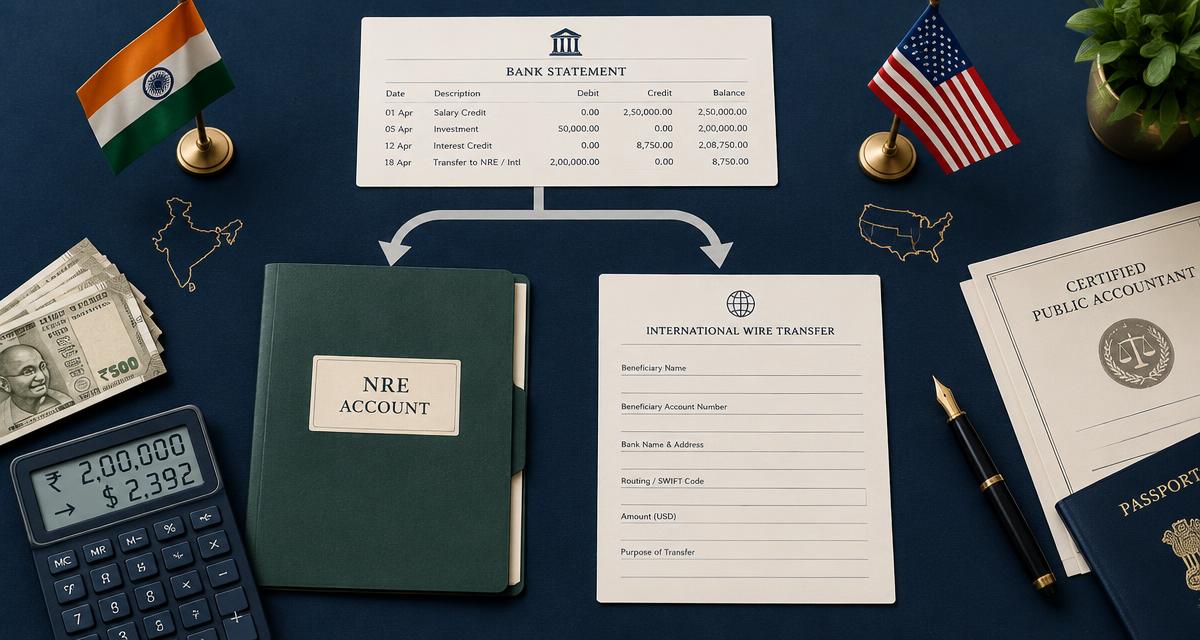
A side-by-side comparison of converting NRO funds into an NRE account versus repatriating NRO funds directly abroad, covering FEMA documentation, chartered-accountant certification, annual ceilings, and timing for NRI families in the US and India.
An NRO to NRE fund transfer is the method most NRIs reach for first when they want to move India-based money abroad, but it is not the only method, and it is not always the faster one. A second route, repatriating directly out of the NRO account, skips the conversion step entirely and sends money abroad on its own documentation and ceiling. Families often pick between the two without realizing a choice is even being made, then discover partway through that the bank is asking for a different form than the one they prepared.
For the NRI in the United States, the practical question is which route gets the money into a US bank account with the fewest round trips of paperwork. For the family member or representative in India, the question is which bank officer, which form, and which chartered accountant certificate the chosen route actually requires. This guide sets both routes side by side so each side of the transaction can plan from the same page.
Converting NRO funds into an NRE account and repatriating NRO funds directly abroad both move the same rupee out of India in the end. They differ in the account that holds the money along the way, the paperwork that clears it, and how the funds behave afterward.
Why NRO and NRE Accounts Are Treated Differently Under FEMA
An NRE account holds foreign earnings an NRI has chosen to bring into India, and under the foreign exchange framework that money is treated as freely repatriable because it came from abroad in the first place. An NRO account holds money that originates in India itself: rental income, dividends, maturity proceeds, inheritance, or the sale proceeds of property. Because NRO funds are India-sourced, moving them abroad is treated as an outward transfer that needs its own certification, documentation, and in most cases an annual ceiling, regardless of which of the two routes is used to send them.
This distinction is the reason a bank asks different questions depending on which account the money currently sits in. An NRI who assumes all their India accounts work the same way is usually the one surprised by an unexpected certificate request midway through a transfer.
Route One: Converting NRO Funds Into an NRE Account
Converting eligible NRO funds into an NRE account is often the more flexible route once the conversion itself is complete, because funds that have genuinely crossed into the NRE account then carry the same repatriable character as any other NRE balance.
- Identify the exact source of the NRO funds and confirm it qualifies for conversion, since not every NRO balance is eligible on the same terms.
- Obtain the chartered accountant's certification of the source and the applicable tax position for that amount.
- Submit the bank's conversion request along with the source documentation and the completed certification.
- Confirm the applicable per-financial-year ceiling against the amount being converted, since the ceiling applies to the conversion itself.
- Retain the bank's confirmation and the certified paperwork, since a second conversion later in the same year will be measured against the same annual figure.
The chartered accountant's certification is the step most families underestimate. Tax and GST compliance work of this kind depends on accurate source classification: a certificate that misdescribes the nature of the funds can be rejected by the bank even when the underlying transfer would otherwise have been permitted.
Route Two: Repatriating NRO Funds Directly Abroad
The second route skips the NRE account altogether and sends NRO funds straight to a foreign bank account. The documentation is broadly similar to conversion, since both routes rely on the same source-of-funds and tax-certification logic, but the money never passes through an NRE account on its way out.
| Convert NRO to NRE first | Repatriate NRO funds directly | |
|---|---|---|
| What happens to the money | Moves into an NRE account in India, then behaves like any NRE balance | Moves straight from the NRO account to the foreign bank |
| Core paperwork | Source documentation plus chartered accountant certification for the conversion | Source documentation plus chartered accountant certification for the outward remittance |
| Annual ceiling | Applies to the amount converted | Applies to the amount remitted |
| Useful when | The NRI expects to hold rupee funds in India for a while before deciding to send them abroad | The NRI already knows the money is leaving India and does not need an intermediate NRE balance |
| What it does not do | Does not itself send money abroad; a separate transfer is still needed afterward | Does not create a repatriable NRE balance for future flexibility |
Neither route is inherently superior. A family expecting further India-side transactions on the same funds, such as reinvesting part of a property sale before deciding how much to send abroad, often finds the NRE conversion more useful, since the money stays repatriable without a fresh certificate every time a portion moves. A family that already knows the destination and timing of the transfer, with nothing further planned in India, often finds direct repatriation the shorter path, since it avoids one extra account entirely.
How NRIs Actually Repatriate Money From India to the US
Once a family has decided whether to convert first or repatriate directly, the mechanics of getting money into a US account follow a similar sequence either way.
What does the bank ask for first? Ordinarily the account statement showing the funds, the source documentation (a sale deed, maturity advice, dividend statement, or similar record depending on where the money came from), and the chartered accountant's certification confirming the applicable tax position.
Does the bank check the tax position before remitting? Yes. The certification is meant to confirm that applicable tax on the underlying income has been addressed, and a bank will generally not process the remittance without it.
Is there a limit on how much can move abroad in a year? A documented per-financial-year ceiling applies to NRO-sourced funds, whether they are converted to NRE first or repatriated directly. The current figure should be confirmed against the bank's published guidance rather than an older number, since it is periodically reviewed.
How long does the transfer typically take once paperwork is complete? Once the certification and supporting documents are in order, the bank's own processing time is usually the remaining variable, and it differs from bank to bank and branch to branch.
Can a representative in India complete this without the NRI being present? Much of the document collection and bank coordination can be handled by a family member or representative acting under a properly authenticated and sufficiently specific Power of Attorney, though the NRI may still need to confirm account details or sign a declaration the bank requires directly from the account holder.
A Hypothetical Illustration: Converting First or Repatriating Directly
Consider a hypothetical scenario with invented facts. Suppose an NRI named Rina, living in Ohio, inherits a matured fixed deposit that sits in an NRO account in Kolkata following a family member's passing. She is unsure whether she will need part of the money for a possible property purchase in India within the next year, or whether she wants all of it in her US account as soon as possible.
If Rina converts the NRO funds into an NRE account first, she keeps the flexibility to leave the money in India a while longer, then send some or all of it abroad later without redoing the certification for the India-side portion. If she instead repatriates the full amount directly, she avoids holding an intermediate NRE balance, but she also forecloses the option of easily redeploying part of the funds in India without bringing new money back in. Neither choice is right in the abstract; it depends on whether she expects to need rupee funds in India again soon. This illustration is hypothetical and does not describe any actual client or matter.
Who Counts as an NRI for These Purposes
The classification that governs which account rules apply is not always obvious to someone who has recently moved abroad or recently returned. Status can shift during a tax year, and the account type a person should be using can shift with it. A returning NRI, for example, generally needs to review existing NRE and NRO holdings rather than assume they continue unchanged once residence status in India changes. Getting the classification wrong at the outset tends to surface later as a documentation mismatch when a transfer is attempted, which is one more reason to confirm status before, rather than after, a conversion or repatriation request is submitted.
Coordinating the Certification, the Bank, and the India-Side Paperwork
Both routes depend on the same three pieces moving in sync: the source documentation establishing where the money came from, the chartered accountant's certification confirming the tax position, and the bank's own conversion or remittance form. A gap in any one of the three is usually what stalls a transfer that otherwise qualifies. Where the underlying funds came from a property sale, the property and real estate side of that transaction, including title clearance and sale-deed registration, should already be complete and on file before the certification is requested, since the certifying accountant will ask for it. Where the funds instead relate to dividends or a buyout from a company the NRI holds shares in, the classification question connects back to how that corporate investment was originally structured and reported.
Coordinating the certification, the bank submission, and any outstanding India-side documentation is the kind of multi-step sequencing that IndusGuard's NRI legal services team can help keep aligned, so that a family does not discover a missing document only after the bank has already declined a request.
A Factual Note on the Working Model
IndusGuard Estate & Legal Services LLP coordinates advocates, Chartered Accountants, Company Secretaries, and Estate Strategists across its Kolkata and Miami offices, with routine India-side steps structured so a client abroad is not ordinarily required to travel to India. This is a factual description of the team and process, not advice on a particular remittance.
Sources
- Reserve Bank of India: Master Directions on remittance of assets, https://www.rbi.org.in
- Income Tax Department of India: Form 15CA and Form 15CB guidance, https://www.incometax.gov.in
- Reserve Bank of India: Frequently asked questions on NRI accounts, https://www.rbi.org.in/commonperson/english/scripts/FAQs.aspx
Frequently Asked Questions
NRO to NRE Transfer: Rules and Process
Tax, Certification, and Documentation
Direct NRO Repatriation Abroad
FEMA Status and Related NRI Rules
Practice areas related to this topic
Related reading
IndusGuard Estate & Legal Services LLP coordinates advocates, Chartered Accountants, Company Secretaries and Estate Strategists across its Kolkata and Miami offices, with routine India-side steps structured so a client abroad is not ordinarily required to travel to India.
Disclaimer: This article is published for general informational and educational purposes only. It does not constitute legal advice and does not create an advocate-client relationship. IndusGuard Estate and Legal Services LLP is governed by the Bar Council of India Rules. Readers should not act on this information without consulting a qualified legal practitioner.
Offices: Kolkata, India · Miami, USA | Phone India: +91 98367 33009 | Phone USA: +1 (309) 533-8083